The Parent's AI Tutoring System turns the ChatGPT account you already have into a patient, personalized tutor for your child — one that guides, never hands over answers, and knows exactly how your kid learns. Set up in one evening. $37, once.
Get Instant Access — $37 Instant download · 30-day money-back guarantee
Sometimes it's the kid. Sometimes it's the parent. The homework is due tomorrow, the method the teacher uses isn't the one we learned, and "just read the question again" has stopped working.
The usual options aren't great:
| Option | What it costs | The catch |
|---|---|---|
| A private tutor | $40–120 an hour | Once a week, booked in advance. Homework isn't once a week. |
| A tutoring center | $150–200+ a month | Group sessions, someone else's schedule, a drive each way. |
| Doing it yourself | Your evening | You're tired, they're tired, and nobody remembers long division. |
| Plain ChatGPT | Free | It just gives the answer. Nothing gets learned — and you've built a cheating machine. |
That last one is the interesting one. ChatGPT is already an excellent tutor. The problem is that nobody set it up to tutor — so it does what it's asked, which is "what's the answer to number 7."
1. Who the student is. Visual learner or talk-it-through? Fine with rules, or needs a real example first? Loves horses, hates being rushed? A human tutor figures this out over weeks. Our 20-minute diagnostic turns it into a Learner Profile — one block of text you paste at the top of every session, and the tutor walks in already knowing your child.
2. The house rules. This is the line that turns a homework machine into a teacher:
With those two things in place, the same ChatGPT that would have handed over answer 7 instead asks, "What's the question actually asking you to find?" — and waits. That's tutoring. Everything in this system is built to make it happen reliably, every night, without you having to become a prompt engineer.
ChatGPT asks your child ten playful questions while you watch and tally. You come out with their Learner Profile — how they grasp new ideas, what frustrates them, what they love. Two worked examples show you exactly what "done" looks like.
The Parent's Guide walks you through the family account setup — Study Mode, parental controls for teens, voice mode for younger kids, and the privacy basics. Plain-language, screenshot-free instructions that don't go stale when the app updates.
Stuck on a math problem? Essay due Friday? Test next week? There's a card for it — 34 routines across K–5, middle school, and high school, each a copy-paste prompt with the profile slot built in. Paste, run, sit back.
Built like a workshop manual, not a lecture: every book is something you do, and the cards tell you when to use them.
Book 1
What this is (and what it will never do), the honest cost math, account setup by age, Study Mode, parental controls, voice mode, privacy, and a 7-day plan.
19 pages
Book 2
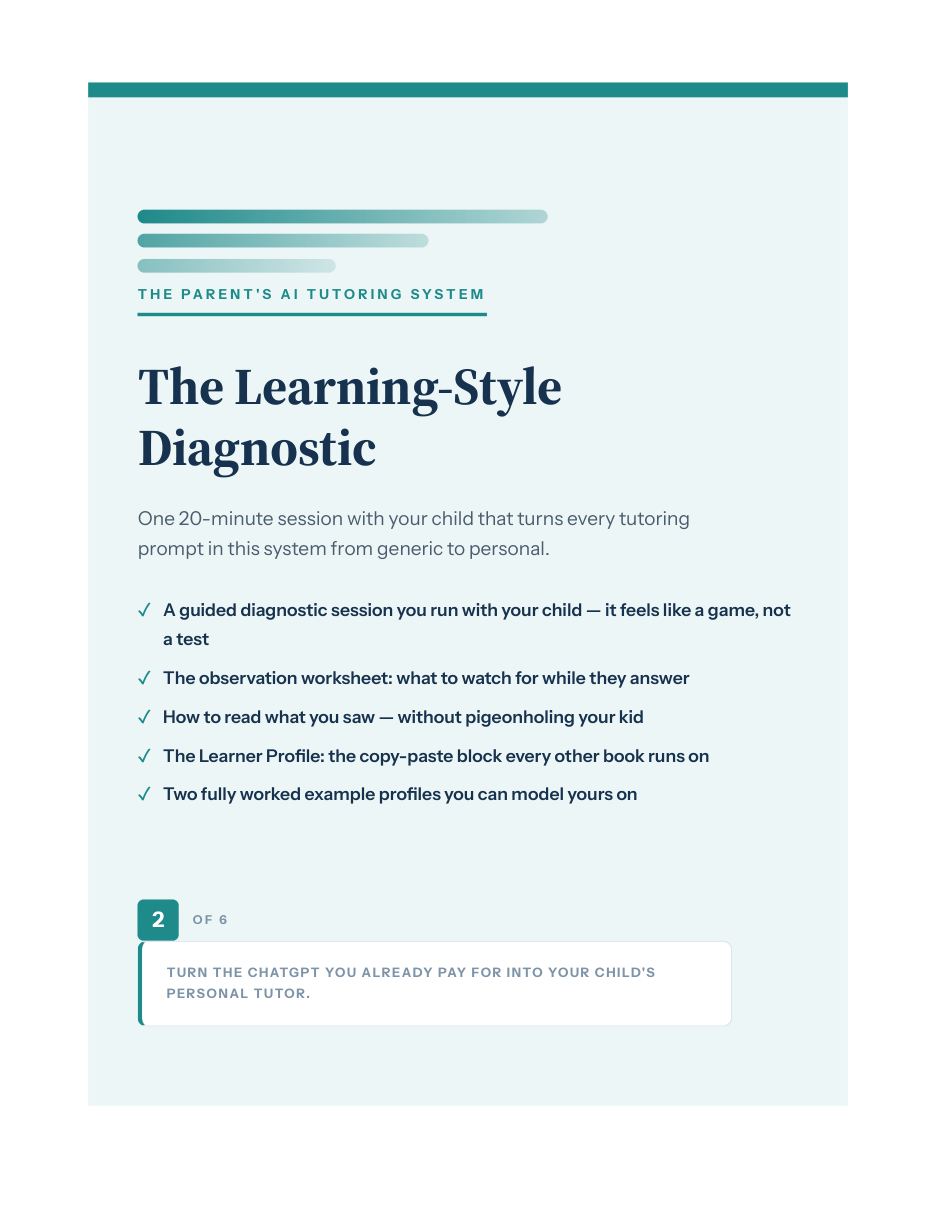
The 20-minute session, the observation sheet, how to read what you saw, and the Learner Profile that makes every later prompt personal.
22 pages · 2 worked examples
Book 3 · The big one
34 tutoring cards — math, reading & writing, science, study skills — in three grade bands. Each one: when to use it, the prompt, what good output looks like, the common mistake.
43 pages · 34 cards
Book 4
Stuck-on-a-problem walkthrough, the wrong-answer autopsy, essay feedback that never writes it for them, drills, the night-before routine, and how to catch the AI when it's wrong.
24 pages · 6 protocols
Book 5
A 10-minute weekly check-in: what was covered, where it wobbled, what to practice next. Printable log, monthly review, and an honest chapter on when a human tutor is the right call.
29 pages
Book 6
Fourteen fridge-door cards: the profile, the house rules, and the most-used routines condensed to one printable page each. Plus the "which card do I need?" index.
18 pages · 14 cardsFifteen more cards for the two weeks before any test — mock-test builders for every grade band, a 14-day spaced revision plan, flashcard and active-recall drills, timed sprints, and calm-and-confident routines including a morning-of-exam card. Add it on the checkout screen if exam season is coming.

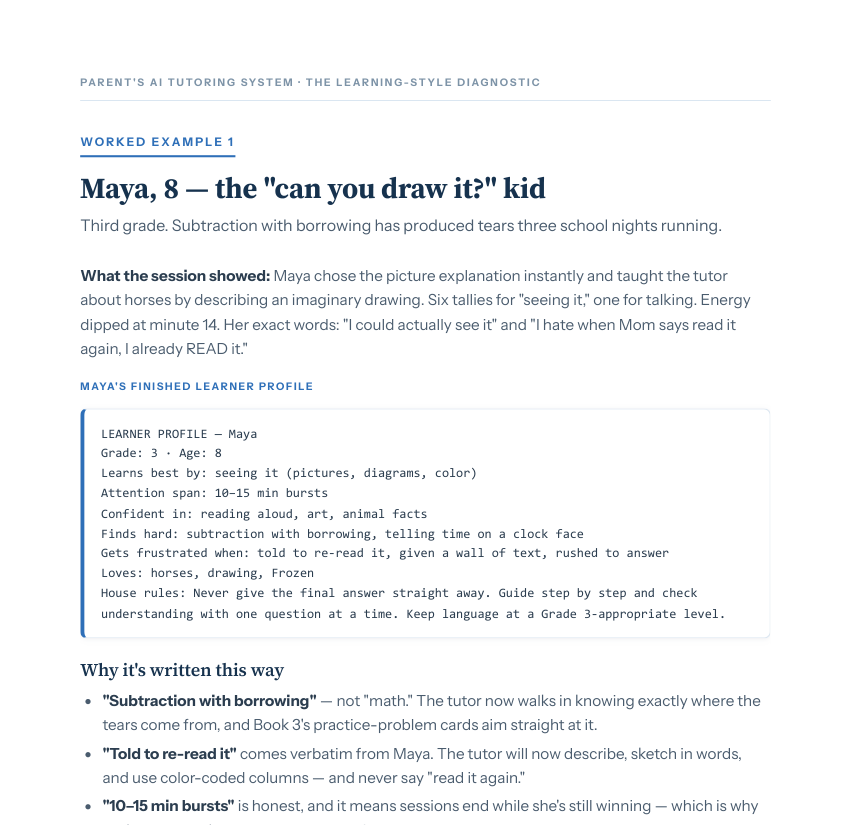
A real worked example — an 8-year-old visual learner — annotated so you can see exactly why each line is worded the way it is.

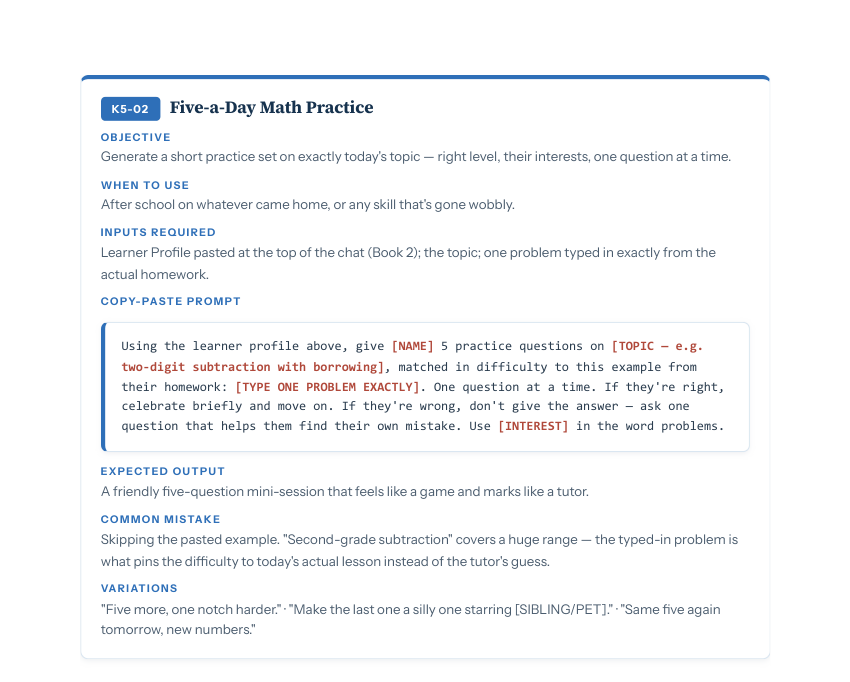
Objective, when to use it, the copy-paste prompt with your fill-in slots, what to expect, the common mistake, and variations. Find the card, run the card.

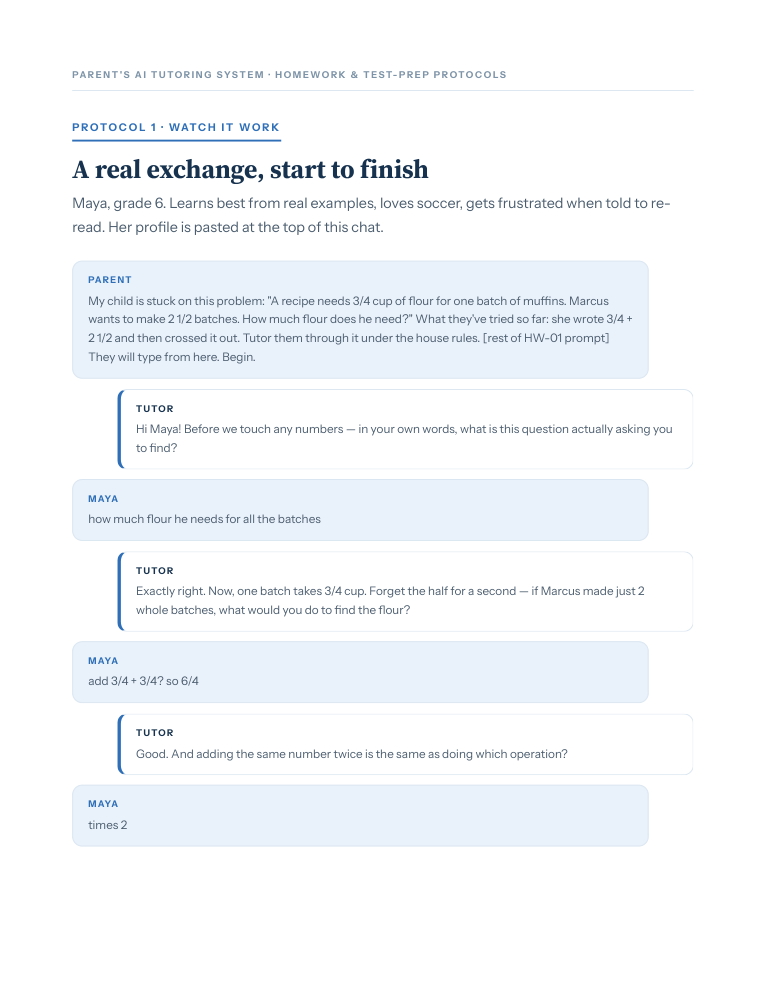
A full stuck-on-a-problem session, turn by turn — fractions, a soccer example, one question at a time — so you know what to expect before you sit down.
We're not going to show you five-star reviews from "Sarah, mom of three" — this is a new product and we'd rather earn those. What we can tell you is checkable:
ChatGPT's Study Mode is real and free — it's OpenAI's own tutoring mode, and this system is built on top of it. Parental controls for linked teen accounts are real. Book 1 walks you through both. The house rule works — paste "never give the final answer straight away, ask one question at a time" into any ChatGPT chat and watch what happens. The system is that principle, plus a learner profile, made repeatable across 34 situations.
What we won't claim: that it raises grades. It makes tutoring available every night for the price of one session, and it makes that tutoring patient and personal. What your child does with that is theirs.
Run the diagnostic. Try the cards on real homework. If it doesn't make evenings calmer within 30 days, reply to your receipt email and we'll refund every dollar. No forms, no questions.
Because Study Mode is a switch, not a system. It doesn't know your child, it doesn't know what to do on a Tuesday when the essay is due Friday, and left alone it will still drift into giving answers when a frustrated kid pushes. This system gives it a learner profile, house rules that hold, and 34 ready-made routines for the situations that actually come up — plus the parent side: a weekly check-in and printable cards. You're paying for the setup and the method, not the AI.
We don't promise that, and we'd be suspicious of anyone who does. What the system reliably changes is availability (a patient tutor every night instead of once a week), personalization (it teaches the way your child learns), and honesty (it teaches rather than answers). Those are the conditions good tutoring creates. Outcomes belong to your child.
Using AI to get answers is. This system is built on the opposite rule — the tutor never gives the final answer, it asks questions until your child gets there. Every prompt carries that rule; Book 4 shows you exactly what a session looks like and how to keep it honest. Most parents find it's the first time they've felt comfortable with AI and schoolwork in the same sentence.
Three grade bands — K–5, 6–8, and 9–12 — with cards written for each. Younger children work with a parent sitting in (Book 1 covers the how); high schoolers can run their cards themselves on a linked teen account with parental controls.
If you can copy and paste, you can run this. Setup is one evening following plain-language steps. The cards are copy-paste prompts with clearly marked fill-in slots. No software, no plugins, no subscriptions beyond the ChatGPT account you already have.
Book 1 has a short privacy chapter: first names only, no school names, which settings to turn on, and how to use a linked teen account so you keep oversight. It's written for parents who take this seriously, because we do.
Seven PDFs (about 200 pages), delivered instantly on your download page and by email — yours to keep, print, and re-download anytime. The Exam-Prep Power Pack is an optional $19 add-on on the checkout screen.
Instant download · Works with free ChatGPT · Refund within 30 days, no questions